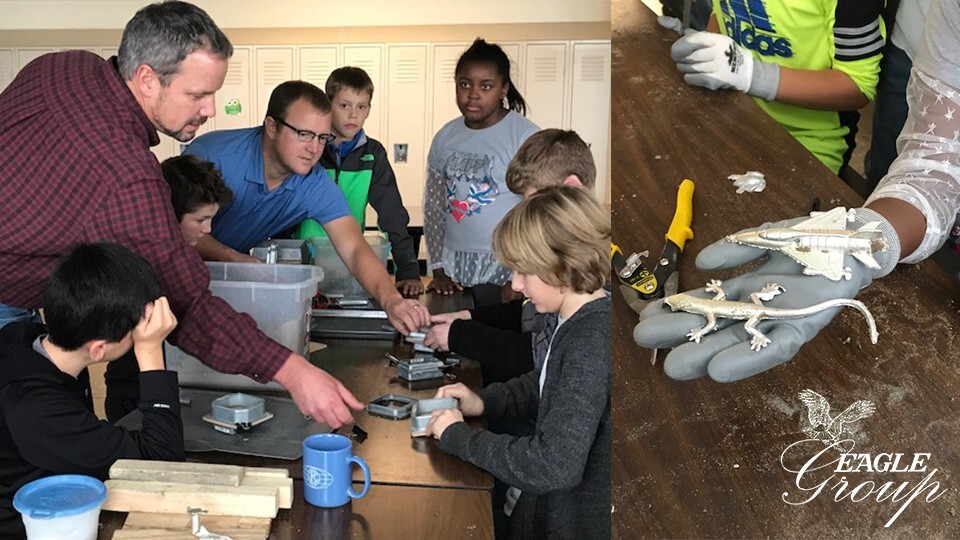
“We do outreach because we care about the investment in the future.”
— Jason Bergman, Eagle Alloy
Michigan ranks #4 in the nation for total manufacturing employment (1). Yet the state—and the nation as a whole—faces a looming manufacturing workforce development challenge. According to a skills gap study conducted by Deloitte and The Manufacturing Institute, more than two million manufacturing jobs could go unfilled by 2030, potentially costing the United States economy more than $1 trillion (2). This widening gap between open positions and skilled workers is a pressing issue in today’s fast-changing economy, and it demands creative and collaborative solutions.
This challenge is especially visible in Michigan’s foundry industry, where the question is becoming urgent: who will carry the torch when today’s skilled craftspeople retire? Across the country, manufacturers are confronting the same question as the generational skills gap widens and fewer young people pursue industrial trades.
For the Eagle Group, a family of foundries and a machining facility based in West Michigan, the answer begins not with job postings or perks, but with education, exposure, and hands-on engagement. The company has made long-term investment in the next generation of makers a central part of its mission. That effort takes many forms—from classroom demonstrations for third graders to collaborative casting competitions at nearby universities—building skills, sparking curiosity, and cultivating the workforce of tomorrow
Why Start Community Outreach So Early?
The Eagle Group’s outreach philosophy is simple: the earlier students understand what manufacturing is, the more likely they are to see it as an inspiring and valuable career path.
Many young people (and even adults) have outdated images of foundries as dark, dirty, or low-skill work environments. But the reality inside the Eagle Group’s facilities is quite different. Modern foundries are filled with automation, robotics, digital sensors, and precision tooling, blending traditional craft with cutting-edge engineering. Showing that reality firsthand is key to changing perceptions—and to helping young people understand the economic opportunities available.
"Manufacturing is a significant source of jobs in our country," explains Jeremy Sheaffer, an educator at Whitehall High School who has partnered with Eagle Alloy to bring real-world experience into his engineering classroom. "It's a viable source of income. These are not minimum-wage-paying jobs. They're spots for people to grow. I've been places where people started off on the shop floor as a worker at a young age, and now they're plant managers earning that six-figure living."
But those opportunities only exist if there’s a new generation ready to step in. That’s where the importance of building and maintaining a strong talent stream comes into play, something Eagle Alloy’s Jason Bergman says the industry can’t afford to overlook. “Having the talent stream ready to go into the metalcasting industry is very important, whether that’s local or nationwide,” says Bergman. “We need to keep up the interest not just in foundries, but in manufacturing as a whole, because it’s so necessary for our infrastructure.”
That commitment is what drives the Eagle Group to partner with national and local organizations and educators to bring manufacturing to life for students at every level of learning.
Hands-On Foundry Workshops: Shaping the Next Generation of Metalcasters
American Foundry Society, Foundry-in-a-Box Program
One of the best ways to engage young people is to bring metalcasting education to them. A good example of this is the American Foundry Society’s (AFS) Foundry-in-a-Box program—a mobile classroom experience that introduces the metalcasting process in a safe, hands-on way. In West Michigan, about 20 volunteers, including AFS chapter members and Eagle Group volunteers, bring Foundry in a Box directly to elementary, middle, and high schools.
Jeff Cook of Eagle Alloy has helped lead the program for years. “We get to start with nothing, just a pattern,” explains Cook. “Then the students make a mold, melt tin, and pour it into the mold. After cooling, they hold a finished metal replica in their hands—maybe a frog, turtle, jet plane, or Christmas ornament. It’s a tangible way to connect young folks to manufacturing.”
The session lasts about an hour, but its impact stays with students much longer. “Teachers see the level of engagement that Foundry in a Box brings, and they're just in awe,” says Andy Scherf, the AFS West Michigan Chapter Foundry-in-a-Box Coordinator. Students not only take home a shiny new keepsake; they also take home the story of how it was made and the experience of creating something with their own hands.
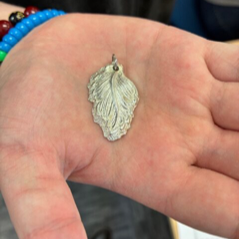
Above: a handmade keepsake created by a Spring Lake Alternative Education student participating in the Foundry-in-a-Box program
That level of engagement is something Jeremy Sheaffer sees firsthand in his own classroom. He says the impact of taking home something students have made themselves is especially powerful. "When the student gets to walk away with a tangible item, that seems to stick with them more, because they’re part of the process.” He compares it to art students taking home paintings or woodshop students leaving with shelves they've built. "You just see a larger group of students engaged."
Foundry Educational Foundation: Metalcasting in the Classroom
The Foundry Educational Foundation (FEF) runs a similar program called Metalcasting in the Classroom that brings curriculum and hands-on foundry workshops to middle and high schools.
The Foundry Educational Foundation’s program focuses on older students. Michelle Kerns, a consultant at Foundry Educational Foundation, explains that the two programs complement each other in many ways. For Foundry in a Box, a main goal is to encourage curiosity and give kids their first exposure to metalcasting—often revealing that manufacturing can be creative, precise, problem-solving, and fun. FEF’s program goes a step further, with the goal to deeply engage students. “Find those kids who show a special interest in metalcasting and really inspire them,” says Kerns. “Create that spark, and then turn that spark into a passion for joining the metalcasting industry, for making it their career.”
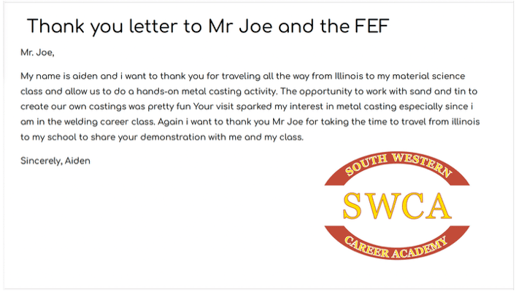
Above: a thank-you letter to FEF coordinators from a student who participated in their casting workshop
For educators looking to maximize student engagement, the key is authenticity. "The number one thing, if I had to tell manufacturers, would be to create authentic projects," Sheaffer emphasizes, "where [manufacturers] are working with students, where students are actually solving an authentic problem." This approach—giving students real design challenges rather than just going through assigned exercises—transforms classroom theory into genuine career exploration.
Programs like Foundry in a Box and those offered by Foundry Educational Foundation introduce students to the world of metalcasting and show them that careers in manufacturing are real and accessible. “Many kids don’t know what a casting is,” says Cook. We want them to see there’s a place for them if they want to create things from nothing.”
From Curiosity to Career Awareness
While elementary-level outreach plants the seed, sustained engagement keeps it growing. The Eagle Group participates in Manufacturing Day and Michigan Manufacturing Week each October, opening its doors to hundreds of middle- and high-school students from across the region. Tours highlight every stage of modern manufacturing—from molten metal pours to robotic machining cells.
The goal isn’t to turn every visitor into an immediate recruit—it’s to show that manufacturing can be both challenging and rewarding, and that it offers diverse and valuable career paths beyond what many students expect.
The next Manufacturing Day is Friday, October 2, 2026. Mark your calendars and plan to get involved!
“You’re not going to nail anything home in a thirty-minute tour,” Bergman admits, “but you might change what a few students think when they hear the word ‘foundry.’ That’s worth it.”
Bridging the Gap with Colleges and Universities
For older students, the Eagle Group helps bridge classroom theory with real-world practice through partnerships like Cast in Steel, a national competition organized by the Steel Founders’ Society of America. In the challenge, university teams design and cast historical replicas—such as axes, swords, or hammers—using professional-grade materials and foundry methods.
The Eagle Group first joined the program through Bergman’s alma mater, Iowa State University, and later brought the initiative closer to home by partnering with Grand Valley State University (GVSU). What began as a single class project has since evolved into a student-led metalcasting club funded by the university.
Cast in Steel 2025 and the Future of America
The collaboration allows GVSU students to visit the foundry, design tooling, assist with molding and pouring, and perform finishing work on their own cast parts. Along the way, they learn about casting design principles, 3D-printed molds and cores, tooling trade-offs, and process scheduling realities—the kinds of lessons no textbook can fully capture.
“They start by thinking, ‘We’re just making a sword,’” Bergman says. “By the end, they’ve learned about design, metallurgy, and production planning—and they’ve got something tangible to show for it.”
These experiences also teach students that manufacturing operates on real deadlines. When one GVSU team’s design changes came in late, the foundry couldn’t pour their preferred alloy without disrupting production schedules—a valuable lesson in logistics and accountability that mirrors professional life.
A Community-Scale Effort
The Eagle Group’s community engagement doesn’t happen in isolation; it’s supported by a network of active and retired foundry professionals, local educators, and regional trade associations who share the same goal of keeping manufacturing knowledge alive through collaborative workforce development initiatives.
Cook highlights the collaborative nature: “It's a joint effort between people who have a real passion for advocating to young people and teaching them what metal castings are, because we believe it’s a fascinating career path.”
The company also participates in local job fairs and community-college events throughout the year, often alongside its HR, engineering, and quality teams. While not every student walking through a job fair is ready for a foundry career, each interaction helps demystify the industry and keeps the Eagle Group’s name familiar in the region’s technical education ecosystem.
Even informal collaborations can lead to powerful outcomes. Through word of mouth within the Steel Founders’ Society, foundries often share ideas, resources, and even customer leads—strengthening the industry as a whole rather than treating peers as competitors. That sense of shared purpose extends naturally to community outreach.
Long-Term Thinking in a Fast-Changing Industry
The Eagle Group’s leadership understands that manufacturing workforce development won’t fill every open position overnight. The impact is measured in years, not quarters. But investing in education today helps ensure a sustainable talent pipeline tomorrow.
“We don’t expect immediate dividends,” Bergman explains. “What matters is that we’re helping build awareness—showing young people that manufacturing is creative, technical, and essential.”
Programs like Foundry in a Box and Manufacturing Day, and initiatives like Foundry Educational Foundation and Cast in Steel, ensure that the next generation sees manufacturing as more than a job—it’s a career and a contribution to society.
Looking Ahead
By meeting students where they are—whether that’s a classroom, a college lab, or a shop-floor tour—the Eagle Group is reshaping how young people see the future of manufacturing and ensuring that Michigan’s foundry industry continues to thrive.
Get Involved
Educators, counselors, and program coordinators can learn more about bringing these experiences to their students:
Foundry-in-a-Box sessions—available for elementary, middle, and high schools throughout the academic year.
- Visit the American Foundry Society to learn how you can get involved
- For West Michigan FiB inquiries, contact Andy Scherf
Foundry Educational Foundation’s Metalcasting in the Classroom—available for middle and high schools throughout the academic year.
- For information on FEF’s Metalcasting in the Classroom Outreach Program, visit their page on the web
- To participate in the program, contact Program Director Michelle Kerns
Manufacturing Day tours—every October, for middle and high-school groups.
- Visit the Manufacturing Day website for resources to help get involved
- To schedule a Manufacturing Week tour of Eagle Group facilities, contact Jason Bergman
University partnerships—opportunities for engineering or design programs to collaborate on future Cast in Steel projects.
- Visit SFSA to learn about this year’s Cast in Steel competition
- See a case study of the Eagle Group’s Cast in Steel teams
References
(1) Michigan Economic Development Corporation. Michigan Workforce and Talent. https://www.michiganbusiness.org/why-michigan/workforce/
(2) Deloitte Insights and The Manufacturing Institute. Creating pathways for tomorrow’s workforce today: Beyond reskilling in manufacturing. Deloitte, 2021. https://higherlogicdownload.s3.amazonaws.com/FLORIDAMAKES/61ce150a-fea4-4735-bbb6-b30a52e237b2/UploadedImages/DI_ER-I-Beyond-reskilling-in-manufacturing__3_.pdf
Tags: American Manufacturing, Education, Community, Students
Written by Nic Tarzwell
Nic Tarzwell is Chief Technical Officer at Eagle Alloy, Inc. He has been with the company since 2007.