

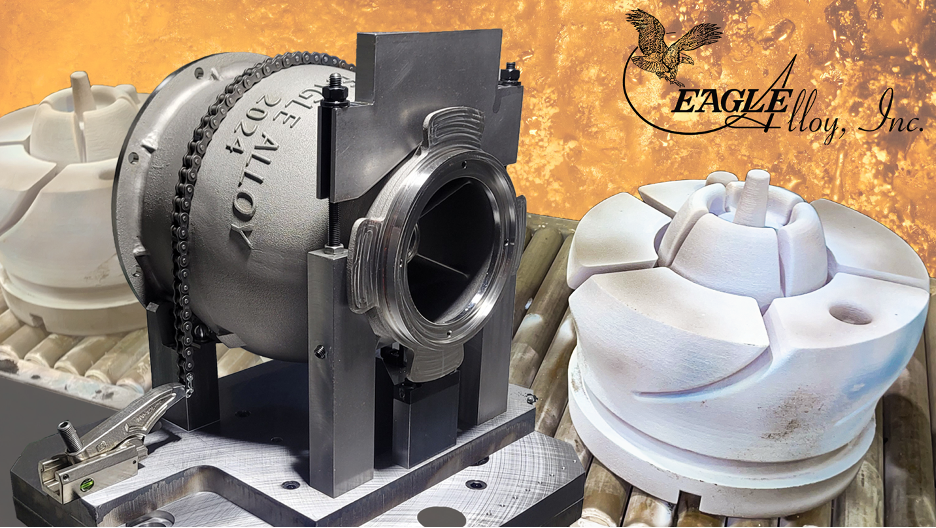
When time and flexibility are top priorities, rapid prototyping for castings offers manufacturers a fast-track route to producing complex cast parts in small quantities. At the Eagle Group, this advanced approach supports both prototype development and low-volume production, helping customers refine designs, verify performance, and move from concept to production quickly without the long lead times associated with permanent tooling.
This article breaks down how the rapid prototyping workflow at the Eagle Group functions—from digital modeling through printing and final casting—and how integrating 3D-printed sand molds into our airset process gives customers a fast, adaptable path for low-volume production, iterative design, and legacy part restoration.
What is Rapid Prototyping for Castings?
Rapid prototyping for castings is the use of advanced techniques to quickly create functional physical prototypes—or the patterns, molds or cores used to make them—without traditional permanent tooling. As the name suggests, the main distinction between rapid prototyping and traditional prototyping is speed: rapid prototyping delivers results faster.
“We might be able to quote samples using 3D-printed molds in six to seven weeks, whereas samples from production tooling might be 14, depending on the customer and what their needs are,” says Jeff Cook of Eagle Alloy, comparing the speed of rapid prototyping to traditional casting workflows.
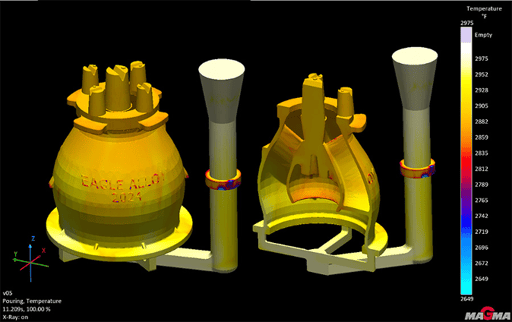
Above: Casting simulation using MAGMA software
While speed is the defining advantage, rapid prototyping is not a single process but a range of manufacturing approaches, each suited to different stages of development and types of parts. In metal manufacturing, rapid prototyping methods are broadly grouped into three categories: additive, subtractive, and formative.
Additive manufacturing, which includes 3D printing, is one of the main technologies that makes rapid prototyping possible. Because it can generate functional prototypes quickly, it’s advantageous in projects where designs are expected to change and flexibility is important. This shortened development cycle makes additive manufacturing a valuable technology for prototype and low-volume casting projects.
However, additive manufacturing alone is often incapable of delivering functional metal parts to spec. In order to deliver castings with similar properties to those produced through shell molding, airset casting, or investment casting, foundries like ours work together with additive manufacturing specialists.
Eagle Alloy, the Eagle Group’s shell mold and airset foundry, often employs 3D-printed sand molds for rapid prototyping of castings. We work closely with trusted additive partners like Humtown Additive to seamlessly incorporate 3D-printed sand molds and cores into our foundry operations. Starting with a digital model of a part, specialized printers create sand molds and cores by building them up layer by layer. Once printed, each mold is cleaned, cured, and then delivered to Eagle Alloy for pouring and finishing.
This tooling-free approach is well-suited for jobs that require quick iterations or call for only a small number of parts. It also enables internal features and design complexities that are difficult—or sometimes impossible—to achieve with traditional core-making methods.
When does rapid prototyping make sense for metalcasting?
Rapid prototyping is most effective when speed, flexibility, or design complexity are key drivers in a casting project. The process is ideal for:
- Testing new designs or materials before committing to permanent tooling
- Achieving a functional prototype without permanent tooling investment
- Producing small quantities (less than 100 pieces) without long lead times
- Iterating quickly when design changes are expected and flexibility is needed
- Casting parts with complex geometries, like meshes or overlapping internal channels
- Meeting development cycles that require short lead times
- Converting fabricated components to cast components when early validation is necessary before full production
- Replacing legacy or hard-to-source parts when original tooling is unavailable or cost-prohibitive to reproduce
Dimensional Tolerances & Casting Details
Eagle Alloy’s 3D-printed mold castings achieve tolerances comparable to our standard airset process. These dimensional tolerances and part characteristics are summarized below:
Dimensional Tolerances
Linear: ±0.045″ per inch
Angular: ±1 degree
Casting Characteristics
Surface finish: 200-420 RMS
Minimum wall thickness: 0.250″ (6.35mm)
Typical part weights: 2-400 lbs
Typical run sizes: 1-100 parts
Rapid Prototyping Process Overview
We partner with reliable additive manufacturers to produce sand molds and cores directly from our customers’ CAD models, then integrate them into our pouring and finishing workflow to create full-density steel castings. The steps below detail how the rapid prototyping process at Eagle Alloy unfolds.
- Discussion of project goals with customer
Every rapid prototyping engagement begins with a collaborative discussion to understand the customer’s objectives, part requirements, and expected performance. Whether customers bring a concept, a 2D blueprint, a 3D model, or an existing part in need of reverse engineering, we tailor the process to meet them where they are. - Deciding on material
Once a project’s goals are defined, our engineers work with customers to determine the most appropriate alloy based on strength, durability, operating environment, and cost considerations. Material selection at this stage ensures that all downstream design and simulation work is aligned with real-world performance needs. - CAD model development, either directly from customer or aided by Eagle Alloy engineers
Customers may provide complete 3D files, partial dimensional information, or only a physical sample.
- For 2D prints or dimensional lists, our team builds a full 3D model using CAD software.
- If the customer provides an existing part instead of design specifications or blueprints, we must reverse engineer it. Using hand tools, handheld laser scanners, or CMMs, Eagle Group engineers obtain dimensional information, then input the data into CAD software to create a 3D model of the part.
Want to learn more about how we design cast products using 3D modeling and solidification software? Check out our dedicated Designing Cast Products blog post.
- Gating design through gating simulation
Using advanced solidification simulation, we will design and optimize the gating and risers. Simulation allows us to predict how metal will enter a mold cavity and behave as it cools, allowing us to account for natural shrinkage, and address potential defects before pouring. - Partner-supported 3D printing of sand cores/molds
After the gating design is validated, we collaborate with trusted additive manufacturing partners to produce precision mold and core components with bonded sand. - Assembly of printed molds and cores
The 3D-printed mold and core components are delivered to our foundry for assembly. They are combined with traditional pouring workflows at Eagle Alloy to ensures proper alignment, venting, and preparation so that the components perform as intended during pouring. - Casting using conventional pouring methods
With the mold assembled, the part is cast using Eagle Alloy’s standard foundry practices. Operators carefully control pouring temperature, speed, and handling to match the parameters established during simulation and ensure accurate steel castings that are free of porosity and other defects. - In-house testing and validation
Each prototype undergoes thorough evaluation to confirm dimensional and metallurgical integrity. Our inspection methods include: laser scanning, magnetic particle testing, and X-ray inspection.
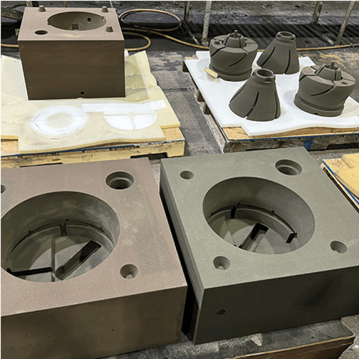
Above: 3D-printed molds and cores at Eagle Alloy, ready for assembly
Eagle Group Rapid Prototype Case Study
If you’re wondering what this workflow looks like in real life, our PBR rapid prototyping project is a great example.
Eagle Alloy and Eagle CNC replicated a key component of a Vietnam-era patrol boat using rapid prototyping and modern cast-and-machine manufacturing. With no blueprint and only a corroded, broken original part, the team had to reverse engineer it—starting with 3D scanning to create a precise digital model.
Eagle Alloy designed the mold, ran solidification simulations, and partnered with Humtown Additive to 3D-print sand molds. Because the original part (made of Ni-Hard iron) had become brittle over time, Eagle Group engineers selected stainless steel for greater durability and long-term performance.
After Eagle Alloy poured the new castings, the parts moved to Eagle CNC, where their team used custom tooling and careful in-process measurement to machine all the critical features and ensure the final assembly would fit and function as planned.
The result? A fully re-engineered stainless-steel component that brought a historically significant naval vessel back to life.
Read the full case study here.
Why demand is growing for rapid prototyping
Demand for rapid prototyping is growing because it eliminates the need for permanent tooling, offers faster iterations with greater flexibility for design changes, enables complex features and internal channels, and shortens development timelines. This workflow—using 3D-printed molds and cores—can get castings into customers’ hands in weeks instead of months. Rapid prototyping gives customers a way to balance speed, design certainty, and project requirements, making it appealing—but only for projects that meet the right criteria.
Rapid prototyping can be especially valuable for one-off, unique, or low-production components, where its flexibility and faster turnaround can outweigh its higher per-part cost. As Cook sums up, “Samples made from 3D printed molds are more expensive, but they're faster.” However, rapid prototyping is not cost-effective for high-volume casting production, and many foundries have difficulty finding uses for the new technology.
At the same time, according to Brandon Lamoncha of Humtown Additive, the industry is increasingly adopting hybrid workflows. “What we’re starting to see more and more of in production is where it’s more of a hybrid process,” Lamoncha says. “A foundry will produce a pattern to create the outside shape of the casting and mold, but the highly complex internals—anything from a turbo housing to a cylinder head and valve bodies for air, hydraulic, or pneumatic systems—those complex geometries are now increasingly being produced using 3D-printing and marrying that with a traditional mold made from a pattern.”
For most projects that move beyond early development, traditional casting methods like shell molding and investment casting still deliver superior accuracy and consistency, with much lower part costs at higher volumes. Therefore, the most effective approach is often not an either-or decision, but a careful evaluation of how rapid prototyping and traditional methods can be applied—individually or together—based on a project’s timeline, design complexity, and quantity needs.
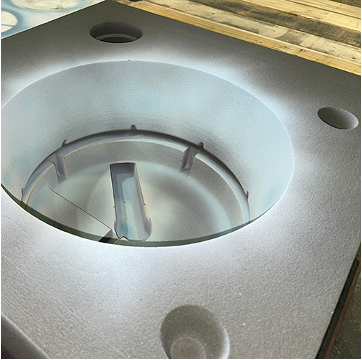
Above: 3D printed mold before core insertion
Why an Experienced foundry Matters for Rapid Prototyping
Partnering with a skilled foundry delivers end-to-end casting expertise that streamlines the entire path from design to production. Clients work directly with us because we hold our rapid-prototyped castings to the same standard as our shell castings. Our pledge is to deliver cast parts to spec, using the best possible manufacturing method for each project.
How Eagle Alloy Supports Your Project, from Start to Delivery
Lamoncha, who regularly collaborates with Eagle Alloy on 3D-printed mold casting projects, sums up the difference that an experienced casting team can make: “We get customers that have an idea on a piece of paper, and we can bring it all the way from a napkin sketch or a 2D print or a 3D model to casting. But the time from when you start talking about a project to the time you get something in your hands can be weeks or months.”
“When working with Eagle,” Lamoncha continues, “Humtown recieves the opposite of Napkin Sketches. Humtown receives complete tech data packages with all clearances, shrink per foot, and other foundry considerations ready to print, making the process and workflow so much more rapid.”
At Eagle Alloy, we not only provide access to 3D-printed molding for quick-turnaround casting jobs, but we offer a high level of casting and engineering expertise for every project. Our engineers assess whether rapid prototyping is the best fit for your timeline, design complexity, and quantity needs, and we provide early guidance to prevent casting issues and avoid costly redesigns. Whether you’re moving from prototype to production or transitioning from welded fabrication to cast components, we’ll guide you through the process and ensure a smooth shift into full manufacturing.
Request a Quote or Contact Our Team to start the conversation.

Written by Jason Bergman
Jason Bergman is Senior Quality Engineer and Metallurgist at Eagle Alloy. He has been with the company since 2013.